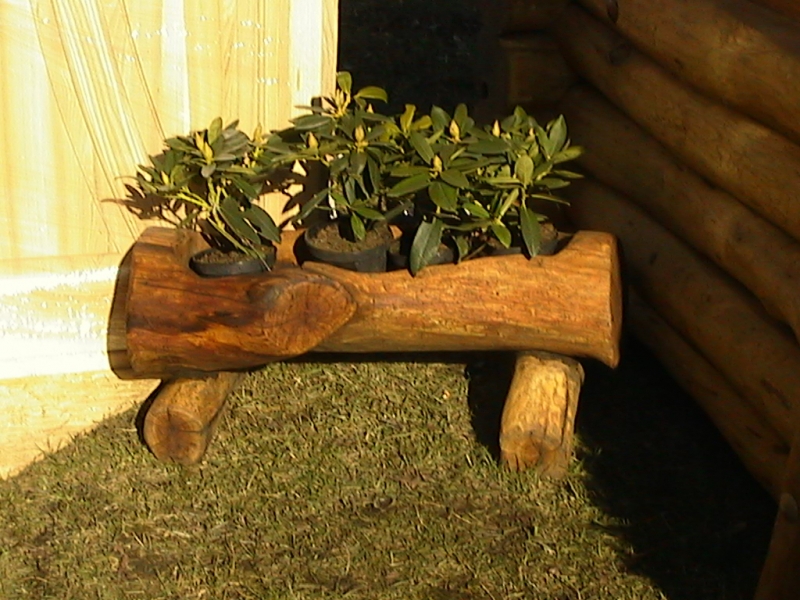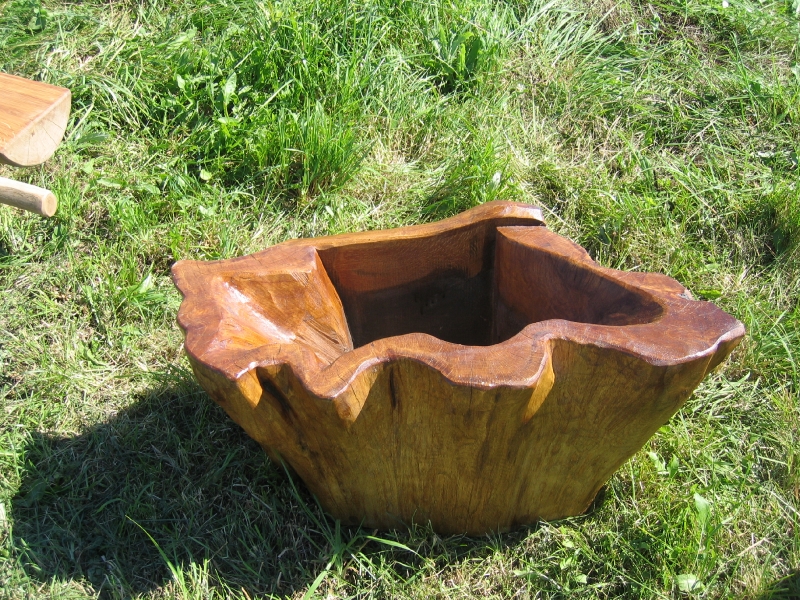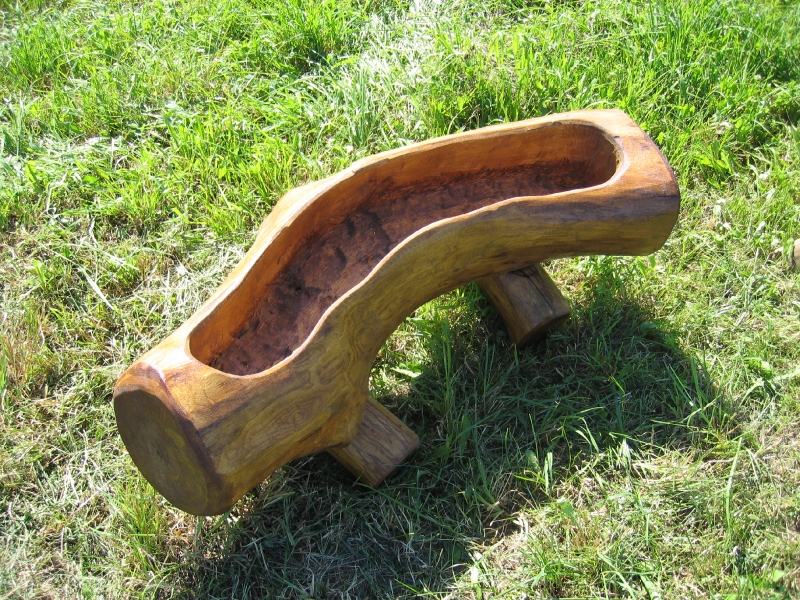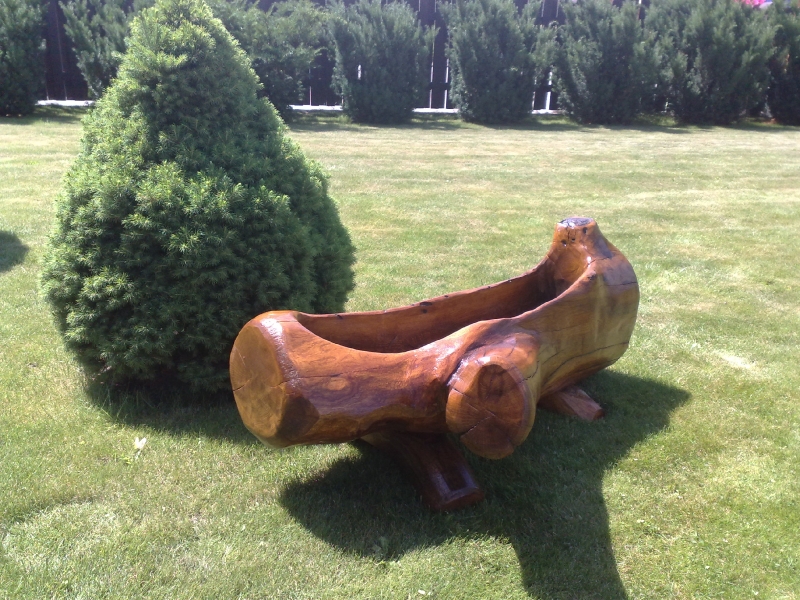
In short: Wooden planter No. 6 is a naturally curved log hollowed out lengthwise, with one end rising upward and a round branch cross-section projecting from the side. The planter is coated with a dark, rich reddish-brown finish and set on crosswise supports. The size, shape and finish are agreed with each customer individually.
A wooden planter among conifers
In the photo the planter stands on a neatly mown lawn, next to a dense cone-shaped young spruce. In the background, along the fence, runs a row of tall conifers. The summer sun lights the planter brightly, and a long dark shadow falls beneath it. The planter is empty, so its shape and cavity are clearly visible.
In this setting the dark wooden planter looks especially harmonious. Its rich color goes with the dark green conifers, and the warm reddish tones stand out against the greenery. The planter and the spruce form a small composition: the vertical, cone-shaped spruce and the horizontal, curved log complement each other.
A spot like this, by a conifer on an open lawn, shows that a wooden planter can be not only a vessel for flowers but also a garden sculpture. Even empty it catches the eye with its shape and color, and planted with flowers it becomes one of the brightest accents of the yard. A planter like this can also be placed where the yard lacks a horizontal line, for example beside tall, narrow conifers.
A tidy garden planted with conifers and a smooth lawn is a fairly strict setting. A planter of natural form brings liveliness and warmth into it without destroying the order: it looks like a well-thought-out detail and not a random object.
In such a spot a wooden planter can also become a kind of sign of the garden. Guests notice it at once, because its shape is like no ordinary planter. It may recall a boat, a clog or an old trough, but in any case it recalls nature and handwork.
A log with a raised end and a branch cross-section
The shape of this planter is unusual. The log lies horizontally, but one end curves and rises upward, so from the side the planter recalls a wooden clog or an old boat. The tree itself determined this shape: where the trunk bent, the craftsmen did not straighten the bend but used it for the silhouette of the planter.
On the front side of the planter a round branch cross-section projects. Where a thicker branch once grew out of the trunk, a round protrusion with clear growth rings was left. It became a decoration of the planter, like a natural medallion on the wood.
The cavity of the planter is hollowed out along the whole horizontal part. Its edges are smooth, slightly wavy, and the raised end forms the taller part of the planter. The other end is cut crosswise, and the cross-section of the log with growth rings can be seen in it.
Under the planter you can see crosswise supports that hold it steady and lift it off the lawn. A gap remains between the bottom of the planter and the grass, so the wood dries faster after rain. The supports are coated with the same dark finish as the planter itself.
In the products of UAB “Laukbaldis” branches, knots and the natural bends of the tree are a sign of individuality. This planter shows it very clearly: its shape was created not by a drawing but by how the tree grew.
Because of the raised end the planter looks dynamic, as if it were moving. Seen from different sides, its silhouette changes: from the front you can see the branch cross-section and the cavity, from the side a striking curved line. So it is worth placing the planter so that it can be viewed from several sides.
A brief summary of the photo
The summary helps you quickly judge the features of this planter. It is a typical example, because every log is different.
| Feature | In the photo |
|---|---|
| Curved log with a raised end | Yes |
| Round branch cross-section on the side | Yes |
| Cavity hollowed out lengthwise | Yes |
| Dark, reddish-brown finish | Yes |
| Crosswise supports underneath | Yes |
| Plants in the planter | No, the planter is empty |
A dark finish: when it suits
Most wooden planters are light, honey-colored or yellowish brown. This planter stands out with a dark, rich reddish-brown finish that gives it solidity and elegance. In the sun the surface glows, and the growth rings and the branch cross-section become even more striking.
A dark finish especially suits:
- beside conifers, as in the photo, where dark wood goes with dark green spruces and thujas;
- beside dark buildings: if the roof of the house, the window frames or the fence are dark, a dark planter echoes them;
- next to bright flowers: against a dark background red, yellow or white blooms look even brighter;
- in modern yards: dark wood looks more restrained and goes with smooth surfaces.
A darker finish also shows small dirt and stains less, which appear when watering or planting. So the planter looks tidy for longer.
If light colors predominate in your yard, you can choose a lighter finish. The shade is discussed when you order, so the planter can be matched with the other products in the yard.
A dark finish has one more property: it visually reduces the size of an object. A large dark planter looks more compact than the same one in a light color, so it also suits a smaller yard or terrace, where a light, massive log might look too big.
What to grow in a planter like this
A long, horizontal cavity suits plants that grow in a row or trail over the edge. The raised end creates a natural height accent, so taller plants can be planted by it and lower ones in the rest.
- Bright summer flowers. Red pelargoniums or yellow marigolds look especially vivid against dark wood.
- White flowers. White petunias or begonias create an elegant contrast.
- Grasses. Ornamental grasses by the raised end emphasize the shape of the planter.
- Evergreen plants. Small evergreen shrubs stay green longer and go with the surrounding conifers.
It is most convenient to plant in a liner or in pots, so that damp soil does not touch the wood. That way the planter will stay beautiful longer, and the plants are easy to change.
If you do not want to plant new plants every year, the planter can be left empty or decorated with natural materials: stones, moss, pine cones or dry twigs. A dark wooden planter with such contents looks like a forest corner in your garden.
Laukbaldis shows only typical examples, so the size and shape of the planter can be discussed. Compare other examples too: the wooden flower trough of a curved log No. 3 and the log planter on legs No. 1. You will find all the planters in the section wooden planters and doors, and furniture with a dark finish in the section oak garden and outdoor furniture.
How to protect dark-coated wood
A dark finish looks lovely, but in the sun it gradually fades, especially on the upper surfaces. To help the planter keep its rich color for a long time, it is worth following a few rules:
- in spring inspect the planter and judge whether the color has faded;
- use a liner so that damp soil does not touch the wood;
- do not let water stand in the cavity; pour it out if needed;
- when renewing the protective coating, choose a similar shade;
- for the winter empty the planter and, if possible, put it under a roof.
The open cross-section of the log at the end and the branch cross-section on the side absorb the most moisture, so inspect them more carefully. Small cracks appear in natural wood as it dries; this is normal and usually does not harm the planter.
When mowing the lawn around the planter, take care that the mower or trimmer does not scratch the dark surface. Scratches show more on a dark finish than on a light one.
A properly kept wooden planter only becomes more beautiful over the years. The wood takes on a deeper shade, the growth rings become more pronounced, and the planter blends more and more into the garden, as if it had always stood there.
How to order planter No. 6
UAB “Laukbaldis” has been making wooden products since 1996 and, according to the company, was the first in Lithuania to start making this production. The company operates in Dapkiškių village, Tauragės district.
Call +370 687 25388 and quote No. 6 from the planters section. Tell us where the planter will stand and what you want to grow in it. During the call you will discuss the approximate length, shape, legs and the shade of the finish. Photos of the yard will help you choose the right shade.
Because every log is bent in its own way, your planter will not be an exact copy of the photo. It will have bends and branch scars of its own, but will keep the same distinctive character shaped by nature.
Do not be afraid to ask for changes: a longer or shorter planter, a deeper cavity, other supports or a lighter shade. If you want several planters that go with each other, say so in advance, and it will be easier to choose suitable logs. Everything is made according to the agreed solutions.
Frequently asked questions
Why is one end of the planter raised?
The planter is made from a naturally curved log whose bend has not been straightened. Because of this, from the side the planter resembles a clog or an old boat.
Can I order a lighter shade?
Yes, the finish is agreed individually. A dark color goes with conifers and dark buildings, and a light one with a lighter setting.
Which flowers look best in a dark planter?
Red, yellow and white flowers look especially vivid against dark wood. Taller plants can be planted by the raised end.
Is the planter stable?
Yes, crosswise supports under the bottom hold the planter. They also lift it off the damp lawn.
How do I keep the dark color?
Inspect the planter every year, and when the color fades, renew the protective coating in a similar shade. Protect the surface from scratches and constant dampness.
How do I order planter No. 6?
Call us and quote No. 6 from the planters section. We will discuss the length, the shape, the legs and the shade of the finish.