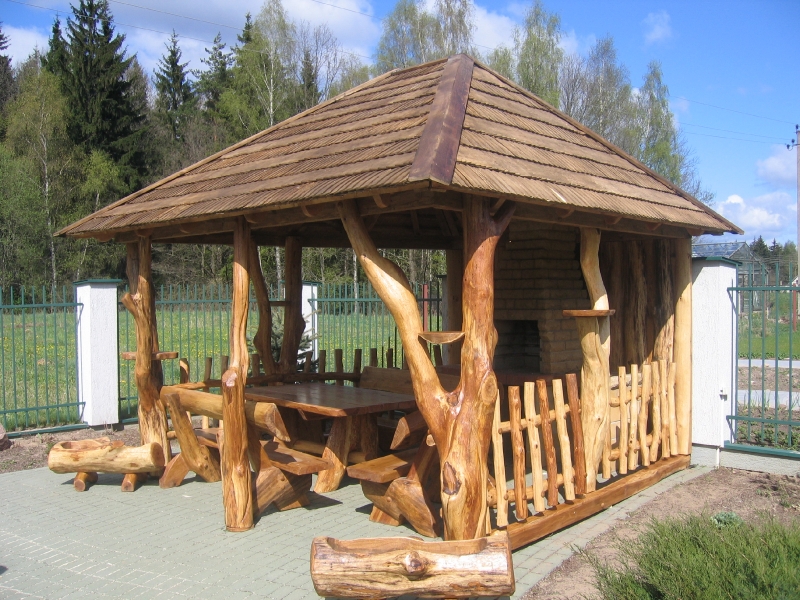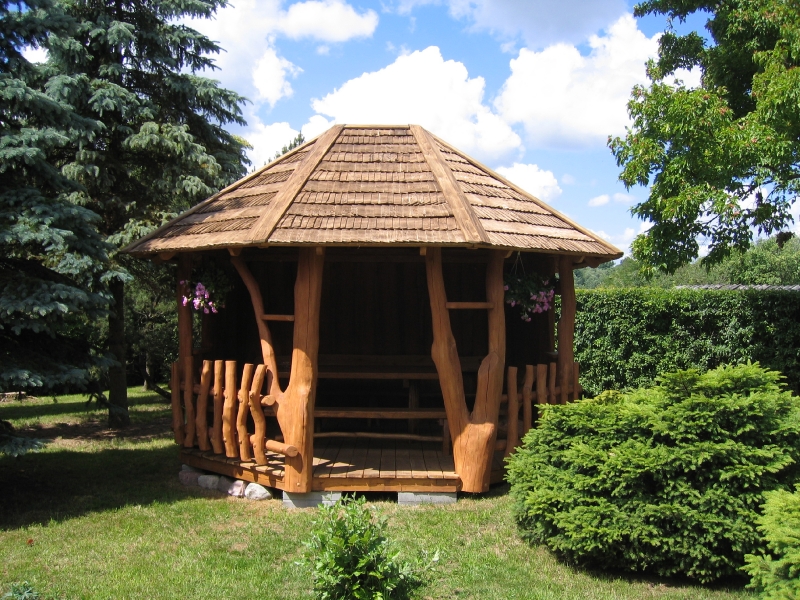
In short: Garden gazebo No. 26-5 is a polygonal wooden gazebo with a light shingle roof, a darker interior and natural, branching trunks on the open side. A low fence of curved stakes is built between the columns, and planters with blooming petunias hang under the roof. In the photo it stands in a sunny garden among spruces, a hedge and conifer shrubs. The size, finishing and equipment are agreed individually.
A garden gazebo decorated with flowers
The photo was taken on a sunny summer day. White clouds float across the sky, the lawn is green, and the gazebo glows in warm shades of wood. On the left stands a large blue spruce, on the right a dense green hedge, and in front grows a round conifer shrub. Surroundings like this create a calm, enclosed corner of the garden in which the gazebo looks like its natural part.
The flowers catch the eye at once. Under the roof, at both places on the open side, hang planters with pink and violet petunias. Their blooms droop downward and contrast vividly with the dark interior of the gazebo. It is the simplest way to decorate a gazebo: nothing in the structure has to be changed, and a few planters and hooks are enough. Bright blooms also attract butterflies and bees, so the whole garden corner becomes livelier.
A garden gazebo is not just a place to eat. It becomes the center of the garden, from which you can see the flower beds, fruit trees and lawn. It is convenient for resting after work, drinking coffee or reading a book when the sun is too hot.
It also matters that the gazebo here is not tucked into a corner of the garden. It stands on an open lawn, visible from afar, and the surrounding plants frame it without overpowering it. That way the structure and the plants complement one another: the trees provide the backdrop, and the gazebo provides the goal that draws the eye.
Hanging flowers: how to decorate a gazebo
Hanging flower planters are one of the favorite ways to decorate gazebos. They take up no space on the floor, they do not interfere with sitting at the table, and the blooms are visible from afar. In the photo the planters are hung under the edge of the roof, on the open side, so they get enough light and the rain does not flood them.
If you want to decorate your gazebo in a similar way, here are a few tips:
- choose flowers that grow well in planters and trail downward: petunias, surfinias, lobelias, pelargoniums;
- hang the planters where they get at least a few hours of sun a day;
- do not hang them right above the table or benches, because when you water, the water will drip on those sitting;
- choose planters with saucers so that water does not run onto the wooden floor;
- take the planters down in autumn so that moisture does not build up on the wood.
Flowers are a way to change the gazebo every season. In spring you can hang pansies, in summer petunias, in autumn heather. Laukbaldis also makes wooden planters, so you can choose standing planters for the surroundings of the gazebo too. A few large planters by the entrance together with the hanging flowers create a unified, festive picture.
A light roof, a dark interior and branching trunks
The roof is made up of several triangular planes meeting at the peak. It is covered with light wooden shingles, and the edges are covered with wide boards. In the sun the shingles look almost golden, and their rows create a rhythmic texture. The roof projects widely beyond the columns, so a deep shadow forms beneath it.
The interior of the gazebo is much darker. The back is closed with darker-colored wood, so from the sunny lawn the inside looks cool and mysterious. This contrast is especially pleasant on a hot day: stepping under the roof, your eyes immediately feel calmer.
The open side is held up by natural trunks. On the left stands a trunk with one branch rising at an angle to support the roof edge. On the right is a thick trunk that divides into two higher up, forming a letter Y. Both are peeled, sanded and coated with a honey-colored layer, so they glow with a warm shade in the sun.
Between the columns there is a low fence of curved stakes. They curve at the top, as if leaning inward, and are set close together. The low fence clearly separates the inside from the lawn, and its wavy line goes with the bends of the trunks. Inside you can see a table and benches, and the plank floor is raised above the ground on stones and blocks.
A short summary of the details in the photo will help you compare this gazebo with others. It is a typical example, and every detail can be discussed.
| Feature | In the photo |
|---|---|
| Roof of light wooden shingles | Yes |
| Branching natural trunks | Yes |
| Low fence of curved stakes | Yes |
| Hanging flower planters | Yes, two |
| Closed rear part | Yes |
| Table and benches | Yes |
| Floor on stones and blocks | Yes |
A gazebo among spruces and hedges
This photo shows well how to fit a gazebo in among plants. The blue spruce on the left provides a backdrop and shelters from the wind, the hedge on the right closes off the view toward the neighbors, and the low conifer shrub in front softens the transition between the lawn and the gazebo.
When planning a gazebo in a garden, a few things are worth taking into account:
- Distance from trees. The branches of big spruces or deciduous trees should not reach the roof, because they shed needles and leaves and can rub against the covering.
- Shade. Trees next to the gazebo give coolness, but in a completely shaded place the wood takes longer to dry after rain.
- A hedge. It closes off the view well and shelters from the wind, but room to walk must remain between it and the gazebo.
- Plants by the entrance. Low shrubs and flowers by the gazebo look beautiful, but they must not block the entrance or get in the way of maintenance.
- Drainage. The spot must be level and dry so that water does not collect under the floor after rain.
Conifers are an especially good choice around a gazebo. They are green all year round, so even in winter the gazebo does not look lonely, and their dark green color nicely sets off the warm shades of the wood.
How a gazebo comes in handy in the garden
In the garden a gazebo often becomes the place where more time is spent than in the house. It comes in handy on various occasions:
- for breakfast or lunch in the fresh air, when the table is already under the roof and does not have to be carried;
- for rest between garden jobs, when you need to hide from the hot sun;
- for evenings with friends, when after dark a lamp is switched on or candles are lit;
- for children playing on a rainy day, when it is wet outside but you do not want to sit at home;
- for sorting seedlings, garden tools or the harvest under the roof.
For the gazebo to be comfortable every day, suitable furniture matters. Laukbaldis makes solid oak garden furniture, so the table and benches can be fitted to the size and shape of the gazebo. When furniture is ordered together, it goes with the trunks, and the interior space is used best. It is worth leaving cushions on the benches that are easy to carry inside in the evening.
It is good when a path leads to the gazebo. Then it is easy to walk there even after rain, and in the evening with a lantern in hand or with lamps installed along the path.
Care through the season
A gazebo in a garden gets a lot of sun, and the plants and trees growing nearby bring leaves and needles. So the care is simple but regular:
- In spring inspect the trunks, the low fence and the floor; if the surface has turned pale or rough, renew the protective coating.
- In summer make sure that when you water flowers the water does not run onto the floor and columns.
- In autumn sweep the leaves and needles off the roof and the floor, and take down the flower planters.
- In winter make sure a thick layer of snow does not build up on the roof.
As they dry, natural trunks sometimes crack on the surface. This is typical of real wood and usually has no effect on strength. Check more closely only the places where branches fork and the upper ends of the trunks, where water can linger. A shingle roof will naturally turn gray with time; if you want to keep the light shade, it can be coated with a protective layer.
How to order gazebo No. 26-5
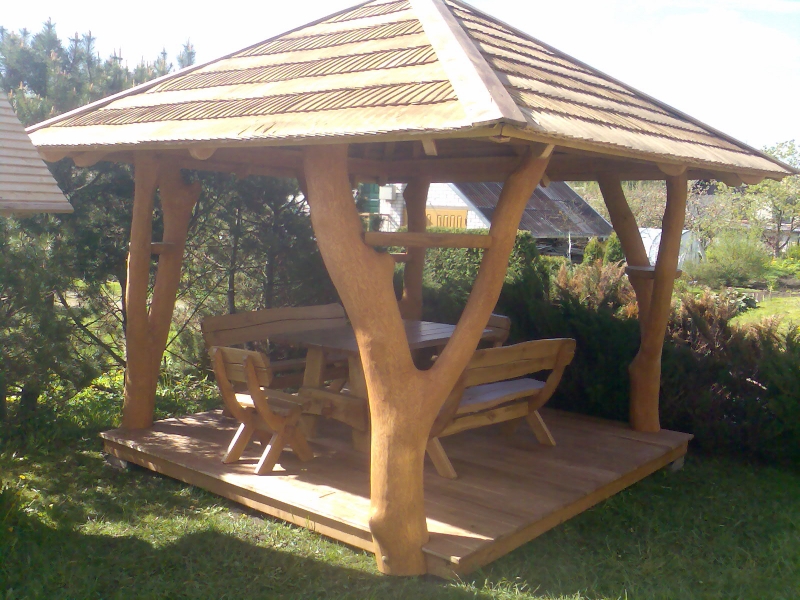
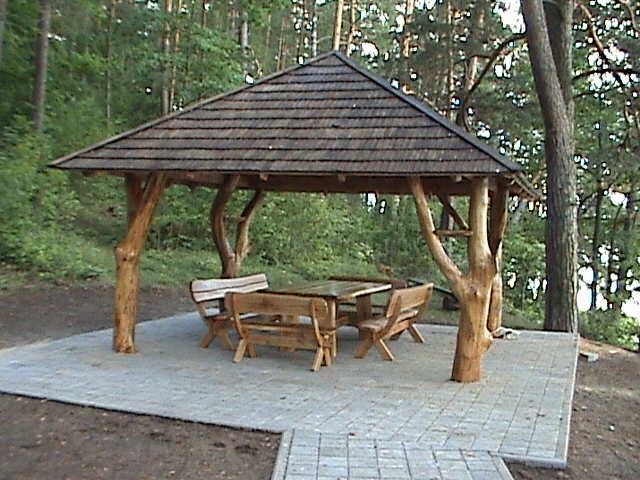
The gazebo belongs to the “Egle-5” series. The website shows one typical variant, so the size, roofing, shape of the low fence, finishing and furniture can be discussed individually. Before calling, think about where the gazebo will stand, how many people will sit at the table and which side you would like to close.
You can draw ideas from other gazebos in the series too: the log gazebo with a tree stump No. 26-4, the octagonal gazebo with a skylight No. 26-3 and the garden gazebo by a blossoming fruit tree No. 25-25. You will find all the examples in the section wooden gazebos, and wooden planters will suit the flowers.
UAB “Laukbaldis” has worked since 1996. Call +370 687 25388 and quote No. 26-5. You will discuss the size of the gazebo, the roof, the finishing, the furniture and the place in your garden. If you have photos or a plan of the garden, have them ready: it will be easier to decide where the gazebo will look best and which side is worth closing against the wind.
Frequently asked questions
What flowers are good to hang in a gazebo?
Trailing flowers that grow well in planters suit best: petunias, surfinias, lobelias or pelargoniums. Hang them where there is enough light.
Can a gazebo be placed under trees?
It can, but the branches should not reach the roof. In a completely shaded place the wood takes longer to dry, so it needs more frequent care.
Can I order a different low fence?
Yes, the shape of the low fence is agreed individually. The photo shows the variant with curved stakes.
What does the gazebo stand on?
In the photo the floor is raised above the ground and rests on stones and blocks. The suitable base is worth discussing according to your plot.
Will the color of the shingle roof change?
Yes, over time the shingles naturally turn gray. If you want to keep a light shade, the roof can be coated with a protective layer.
How do I order this gazebo?
Call us and quote the product number. We will discuss the size, the finishing and the place in your garden.